
First Tool Kits for Auto Mechanics
Starting your journey as a professional auto mechanic is an exciting career move, whether you are fresh out of a vocational school, stepping up from an entry-level position at a quick-lube chain like Valvoline, or transitioning as a career changer from an entirely different industry. However, many newcomers face an immediate "shop floor shock" when they realize they must provide their own mobile workstation and hand tools on day one. The most vital piece of advice for any rookie is simple: do NOT go into heavy DEBT to buy every piece of equipment on your first day. You do not need the most expensive rolling carts or premium name-brand tools to do great work. An automotive career can last a lifetime, and your tool collection is meant to be added along the way as you earn. There is absolutely no need to mortgage the house or sign away your future paychecks to a high-interest tool truck contract just to get started.
The Foundation: The Rolling Service Cart
Before buying a single socket, you need a place to put them. In a modern automotive garage, a 4-drawer or 5-drawer rolling service cart is the industry standard for an apprentice. It acts as your mobile workstation, allowing you to roll 90% of your daily tools directly to the vehicle bay.
- Budget-Friendly Brands: Entry-level carts from brands like Harbor Freight (the U.S. General line) cost around $180 to $290. Home improvement stores like Home Depot (Husky) or Lowe's (Craftsman) offer heavier full-bank carts for $500 to $700.
- If Money Was No Object: Premium rolling carts from mobile tool trucks like Snap-on, Mac Tools, or Matco can easily cost $1,500 to $3,000+ for a similar size.
Must-Have Tool Kit Tools (Day One Required)
These are the absolute essentials you must have to perform basic general repairs, brake jobs, and fluid services on your very first day.
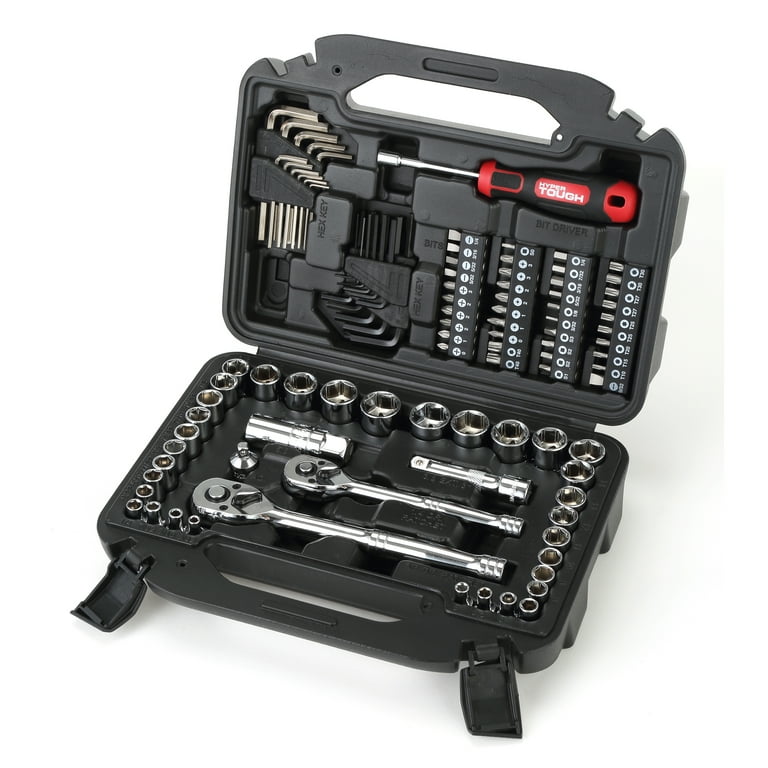
Sockets and Ratchets
- 3/8-Inch Drive Ratchet and Socket Set: Your daily workhorse. Ensure the set is strictly Metric and runs from 8mm to 22mm without skipping critical sizes like 11mm, 15mm, or 16mm.
- 1/4-Inch Drive Ratchet and Socket Set: Essential for small interior pieces, dash components, and under-hood brackets. Look for a Metric run from 4mm to 14mm.
- Extension Bars: A mix of 3-inch, 6-inch, and 10-inch extensions for both drive sizes to reach hidden bolts.
Wrenches, Screwdrivers, and Pliers
- Combination Wrench Set: Standard open-ended/box wrenches. You need a complete Metric run from 8mm to 22mm.
- Screwdriver Set: A multi-pack featuring various sizes of standard Flathead and Phillips-head tips.
- Core Pliers Set: Includes standard slip-joint pliers, needle-nose pliers, diagonal wire cutters, and 10-inch tongue-and-groove (channel lock) pliers.
Safety and General Shop Items
- Safety Glasses and Ear Protection: Non-negotiable safety items required by every shop manager.
- High-Lumen Magnetic Flashlight: A rechargeable light that sticks to car hoods or frames so you can work hands-free.
- Dead Blow Mallet: A 2-pound plastic mallet filled with steel shot to break stuck parts loose without damaging the metal.
The Would-Be Nice to Have but Not Required Tools
Once you survive your first month and collect a few paychecks, these tools should be the very next items you add to your rolling cart to speed up your workflow.
- Cordless 3/8-Inch Impact Wrench: A battery-powered impact gun saves your wrists and shaves hours off your repair times. Brands like Ryobi, Craftsman, or Kobalt provide excellent starter value.
- Torque Wrench (1/2-Inch Drive): Mandatory for properly tightening wheel lug nuts to exact manufacturer specifications. Look for one that handles a range of 20 to 150 foot-pounds.
- Non-Marring Lug Nut Sockets: A dedicated 1/2-inch drive socket set covered in protective plastic. You specifically need 17mm, 19mm, and 21mm sizes, which cover almost all passenger vehicle wheels.
- Digital Multimeter: A basic tool used to test car batteries, check fuses, and track down simple electrical broken wires.
- Ratchet Wrenches: Wrenches with built-in ratcheting ends that fit into tight spaces where a standard ratchet cannot go.
If Money Was No Object Tools (The Extras and Upgrades)
These are high-end, highly specialized, or premium luxury tools. You do not need these to start your career, but they represent what mechanics buy later on when money is no object.
- Premium Tool Truck Hand Tools: Swapping out budget sockets for professional brands like Snap-on or Mac Tools. These offer tighter tolerances, thinner profiles, and highly polished chrome that is easier to clean.
- High-End Heavy Duty Cordless Systems: Professional-grade, high-torque cordless 1/2-inch impact wrenches and grease guns from specialized industrial lines like Milwaukee (M18 Fuel) or DeWalt (XR Series).
- Advanced Diagnostic Scanners: While shops provide standard computers, master technicians often buy personal, high-end diagnostic tablets from brands like Autel or Launch to read complex vehicle data networks right at their cart.
Frequently Asked Questions
Why Do Auto Mechanic Shops Make You Buy Your Own Tools?
Automotive shops expect technicians to buy their own hand tools to ensure personal accountability and proper equipment care. Because mechanics are financially responsible for replacing lost or broken items, tools are kept secure, which avoids communal tool loss and constant workplace arguments. The employer's responsibility is to provide the heavy shop equipment, such as vehicle lifts, alignment racks, tire machines, and specialized computer scanners.
Is A Rolling Cart Better Than A Standard Toolbox For A Beginner?
Yes, a 4-drawer or 5-drawer rolling service cart is the modern standard for entry-level mechanics. Automotive technicians must move constantly between different repair bays and vehicle stalls. A rolling cart acts as a mobile workstation that securely holds about 90% of your daily tools and gives you a flat top lid to use as a work table right next to the vehicle you are repairing.
What Socket Sizes Do I Need The Most When Starting Out?
The vast majority of modern automotive repair uses Metric sizing. A beginner should look for a socket and wrench kit that provides a complete, uninterrupted run from 8mm to 22mm. Avoid cheap starter kits that skip critical sizes like 11mm, 15mm, and 16mm, as these sizes are heavily utilized by manufacturers for brakes, suspension components, and engine mounts.
Do I Need Different Tools To Work On Electric Vehicles (EVs) And Who Pays For Them?
Working on electric or hybrid vehicles requires specialized safety gear due to lethal high-voltage systems. However, entry-level technicians do not have to buy these high-voltage sets. Because of strict OSHA regulations and massive electrocution liability, employers are required by law to provide specialized 1,000-Volt insulated hand tools, Class 0 high-voltage safety gloves, and safety barriers for their employees. Your personal toolkit only needs to cover the standard mechanical components.